
Junglist Arboricultural Consulting
Reference & Discussion

Standards & Journal

A working reference for the Australian Standards we apply in practice, together with occasional field essays on trees, planning and the long view.

Part I

The Standards

AS 4373

2007

Pruning of Amenity Trees

The Australian Standard governing how, where and to what extent amenity trees may be pruned. It defines acceptable pruning types, branch-collar cuts and the limits of crown reduction.

  • Formative, maintenance, crown thinning, crown reduction and clearance pruning.
  • Defines acceptable cut placement relative to the branch bark ridge and collar.
  • Prohibits topping, lion-tailing and other practices that compromise long-term tree health.

AS 4970

2009

Protection of Trees on Development Sites

The framework for retaining trees through design, demolition and construction. Sets out tree protection zones (TPZ), structural root zones (SRZ) and the role of the project arborist.

  • TPZ calculation: 12 × DBH, capped between 2 m and 15 m.
  • SRZ as the minimum area required for tree stability.
  • Encroachment thresholds: ≤10 % minor, >10 % requires arboricultural justification.
  • Defines the duties of the appointed Project Arborist during construction.

ISA BMP

Current

Tree Risk Assessment — Best Management Practice

The International Society of Arboriculture's framework underpinning the TRAQ qualification. Provides a defensible methodology for assessing the likelihood and consequence of tree failure.

  • Levels 1, 2 and 3 inspection scopes.
  • Likelihood-of-failure and likelihood-of-impact matrices.
  • Risk ratings: low, moderate, high and extreme.

QDA Guidelines

Local

Queensland Development Codes & Local Planning Schemes

State and local-government instruments that determine how trees are treated through development assessment — including significant tree registers, vegetation protection orders and offset frameworks.

  • Vegetation Protection Orders (VPOs) and Significant Landscape Trees.
  • Council-specific tree retention policies across SEQ.
  • Offsets, replacement planting and bond conditions.
Part II

From the Journal

Short pieces from the practice — written for arborists, planners and the merely curious. New entries appear irregularly.

Field essay
May 2026
8 min read

On the slow asset: why trees deserve the long view.

Infrastructure is depreciated; trees appreciate. A short argument for treating canopy as the most underrated piece of capital on a council balance sheet — and what that means for the way we write retention conditions.

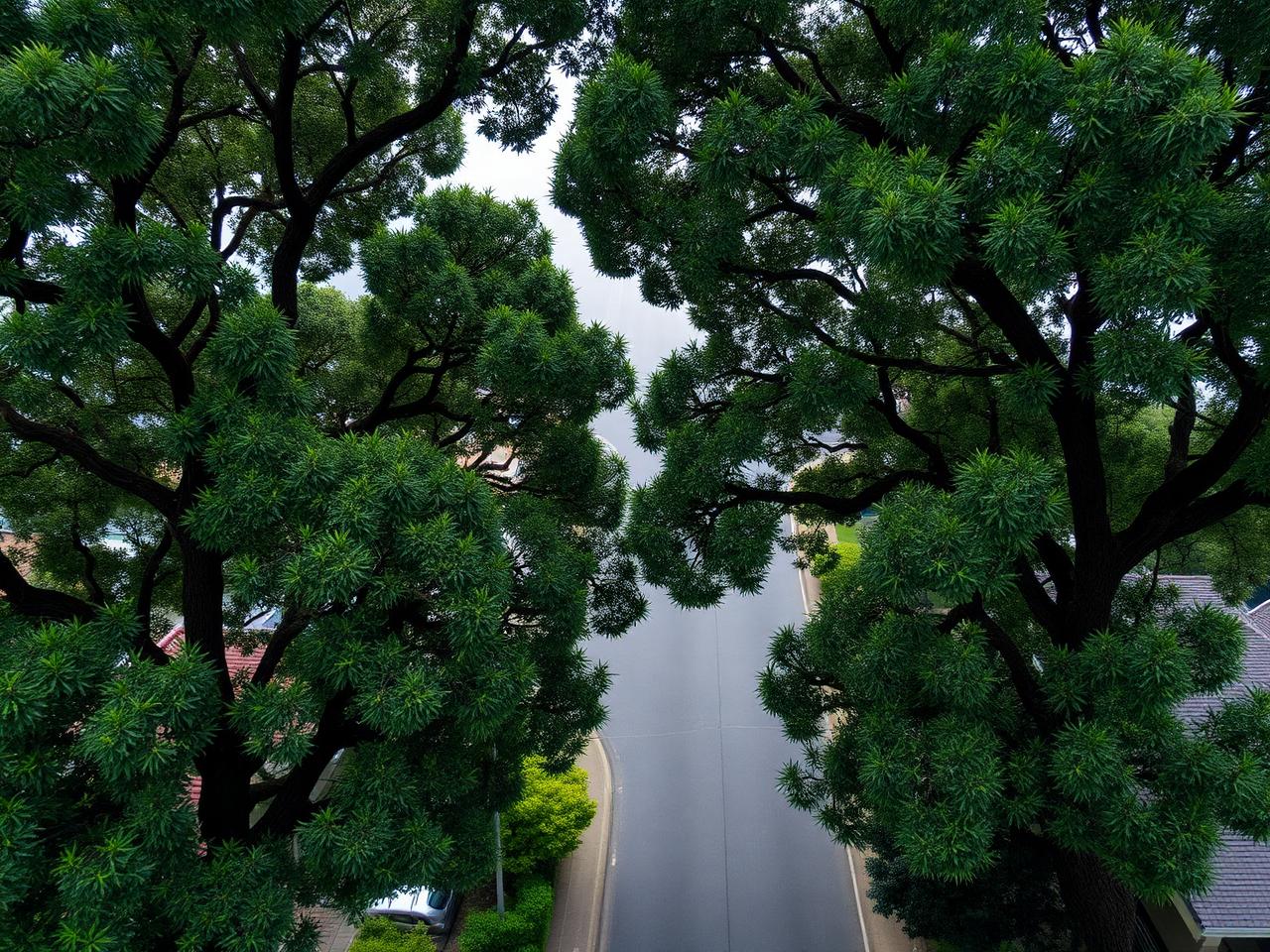
Every other asset a council owns is a depreciating one. The road wears, the pipe corrodes, the building loses a percentage point of book value each year until it is written down to nothing. Trees do the opposite. A semi-mature Lophostemon planted into a verge today is, in real terms, the cheapest version of itself it will ever be. In thirty years that same stem will be shading a footpath, cooling a wall, intercepting a rainfall event and adding measurable dollars to every property within its drip-line — and it will have cost the city almost nothing to keep there.

Standards note
April 2026
5 min read

Reading AS 4970 like a planner, not a checklist.

Most encroachments fail not on the numbers but on the narrative. A working method for writing tree-protection conditions that survive the construction phase intact.

AS 4970 is short. The whole document fits in a back pocket and most of it is diagrams. The trouble is that the parts everyone reads — the TPZ formula, the 10% encroachment threshold, the SRZ calculation — are the easy parts. They are arithmetic. The hard part is the half-page that asks the project arborist to provide an arboricultural justification when the encroachment exceeds the threshold or when the works fall within the SRZ. That paragraph is where most reports quietly fail.

Case study
March 2026
12 min read

650 hollows: what we learned from Australia's largest artificial-hollow program.

Notes from four years installing artificial habitat across the City of Gold Coast — what worked, what didn't, and what an 85–90% occupancy rate actually means in practice.

The program started, as most useful programs do, with a problem we were already paying to solve. Every week the city was removing trees that had reached the end of their structural life — eucalypts and pines in parks, road reserves and bushland edges, most of them with hollows that had taken eighty years to form. The removal was justified. The loss was not accounted for. A natural hollow on the Gold Coast is, on average, more than a century old, and there is no plausible regeneration pathway that replaces one inside a planning horizon.

Discussion
February 2026
6 min read

The myth of the 'safe' tree.

Risk is not zero, and zero risk is not the goal. A frank look at how TRAQ reframes the conversation between arborist, asset owner and the community downstream of every limb.

The phrase 'safe tree' is one of the most expensive two-word combinations in the language. It is what a client asks for when they want certainty, what an insurer reaches for when they want to apportion blame, and what an arborist should never, under any circumstances, sign their name to. A tree is a self-loaded biological structure standing in a wind field. The honest answer to 'is it safe?' is always 'compared to what?'.